Water treatment is one of those home improvements that tends to begin with a small annoyance. Maybe the faucet has developed a stubborn white ring. Perhaps the water tastes a little too much like a swimming pool. Or you’re tired of seeing mineral spots on every glass that comes out of the dishwasher.
At first, it’s easy to shrug it off.
Then the little things add up.
You start wondering whether a filter would help, whether you need a softener, or whether a more advanced system is worth the money. Search online and you’ll quickly find dozens of options, each claiming to deliver cleaner, fresher, better water.
It’s enough to make a simple glass of water feel strangely complicated.
The good news is that choosing treatment doesn’t have to be that way. Start with your water, understand the problem, and then select equipment designed for the job. That’s a much more sensible approach than buying the most impressive-looking system you can find.
Start With a Water Test
Before choosing equipment, find out what’s actually happening in your water.
A water test can identify characteristics that aren’t obvious from taste or appearance. Depending on the source and the concerns involved, testing may look at hardness, pH, iron, manganese, dissolved solids, nitrates, bacteria, or other indicators.
Some companies offer free water testing as part of an initial consultation. That can be useful, especially if you’re unsure whether you need treatment at all.
If testing is offered, ask what the test includes. A quick screening can be helpful, but it isn’t necessarily the same as comprehensive laboratory testing.
The more you know, the less likely you are to spend money solving the wrong problem.
Your Water Source Matters
The water entering your home may come from a municipal supply, private well, rural water system, or another source.
Municipal water is generally treated before distribution, often using disinfectants to help control microorganisms. Some homeowners notice chlorine taste or odor and choose additional filtration for comfort.
Private wells are different. Their water characteristics can be influenced by local geology, groundwater movement, weather, nearby land use, and the condition of the well itself.
So don’t assume a treatment system that works beautifully for your neighbor will automatically work for you.
Water is local. Sometimes extremely local.
Hard Water Leaves a Trail
Hardness is one of the easiest water-quality issues to recognize around the house.
Calcium and magnesium can leave white scale on faucets, shower doors, kettles, and appliances. Soap may also lather differently, and cleaning can become more frustrating.
A water softener can reduce hardness when testing confirms that it’s the underlying issue.
The difference can be surprisingly practical. You may spend less time wiping mineral deposits from fixtures and less effort trying to remove scale from shower glass.
It’s not flashy, but neither is scrubbing the same faucet for the hundredth time.
Filtration and Softening Do Different Jobs
A common misunderstanding is that one filter should be able to handle every water problem.
That’s not how treatment works.
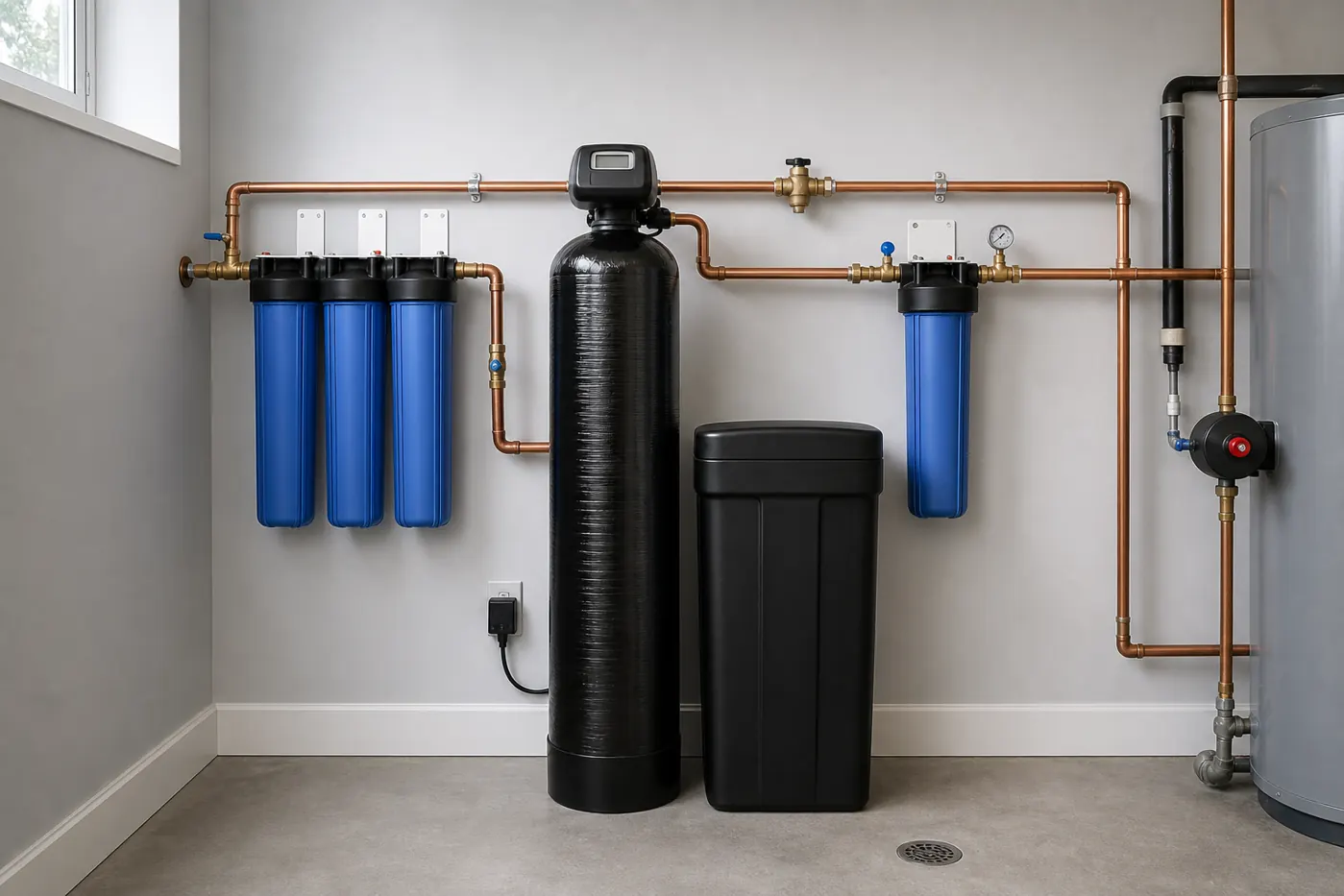
Sediment filters are designed for particles. Carbon filtration can help with certain taste and odor concerns. Water softeners target hardness minerals. Reverse osmosis systems can reduce many dissolved substances in drinking water.
These technologies may sometimes be combined, but each has a specific purpose.
The best treatment setup isn’t necessarily the one with the most stages. It’s the one where each component has a reason for being there.
Think About Drinking Water Separately
Whole-house treatment and drinking-water treatment aren’t always the same thing.
If the water used for showers and laundry is generally acceptable but you want additional treatment for what you consume, a point-of-use system may be practical.
A properly selected drinking water system can be installed at the kitchen sink and provide treated water for drinking and cooking.
Depending on test results, that system might use carbon filtration, reverse osmosis, or another treatment technology.
This focused approach can make sense when your primary concern is drinking water rather than the entire plumbing system.
When Whole-Home Treatment Makes More Sense
Some problems show up everywhere.
If hard water is leaving deposits in multiple bathrooms, affecting laundry, and building up inside appliances, treating one kitchen faucet won’t solve the larger issue.
That’s where whole home filtration or another whole-house treatment approach may be appropriate.
These systems are installed on the incoming water line so treatment can reach multiple fixtures throughout the property.
The exact system depends on the water test. Some homes may need sediment filtration. Others may benefit from carbon treatment, iron removal, softening, or a combination.
Again, the water should determine the equipment.
Don’t Ignore Sudden Changes
One of the most useful things homeowners can do is pay attention to changes.
If water that has always tasted normal suddenly develops an unusual odor, color, or flavor, investigate it.
The cause might be harmless. Changes in municipal treatment, plumbing work, stagnant water, or a filter that has reached the end of its useful life can all affect water characteristics.
For private wells, changes can also be associated with weather, flooding, groundwater conditions, or issues around the well.
A new symptom doesn’t necessarily mean something is seriously wrong. It does mean the situation deserves a closer look.
Reverse Osmosis Has Its Place
Reverse osmosis is popular because it can reduce many dissolved substances from drinking water.
The system uses pressure to move water through a semipermeable membrane. Pre-filters protect the membrane, while post-filtration may improve taste.
But reverse osmosis isn’t automatically the right answer.
It requires suitable water pressure and regular maintenance. It also produces wastewater as part of the treatment process.
If testing shows that your main concern is chlorine taste, carbon filtration might be a simpler solution.
The right technology depends on the actual problem.
Consider Household Water Usage
Water demand matters when selecting equipment.
A small household won’t necessarily need the same capacity as a large family. If several showers, faucets, or appliances operate at the same time, whole-house equipment needs to keep up.
Flow rate and system capacity should be considered during the selection process.
An undersized system can struggle during peak use. An unnecessarily large system may cost more without providing meaningful benefits.
Good sizing is about balance.
Installation Should Be Planned for the Future
It’s easy to focus on getting the equipment installed and forget about what happens afterward.
Filters need changing. Tanks may need servicing. Valves and connections need occasional inspection.
Make sure the equipment is installed where maintenance can realistically be performed.
An under-sink filter hidden behind a pile of cleaning supplies isn’t going to be pleasant to service. A whole-house system wedged into an inaccessible corner can create the same problem.
Good installation considers the future homeowner, not just the installer.
Maintenance Is Part of the Deal
Every treatment system needs some attention.
Filter cartridges eventually become exhausted. Reverse osmosis membranes require replacement. Softening equipment may need salt and periodic service.
Keep track of maintenance dates. Don’t wait until water pressure drops dramatically or taste changes before replacing an overdue filter.
Routine maintenance is usually cheaper and easier than fixing neglected equipment later.
Look Beyond the Initial Price
When comparing systems, don’t stop at the purchase price.
Think about installation, replacement filters, membranes, salt, electricity, service, and other operating costs.
A system with a slightly higher upfront cost might be more economical if its components last longer or are readily available.
Likewise, an expensive system isn’t automatically a better investment.
Ask what each feature does and whether you actually need it.
Ask Questions Before You Buy
A reputable water-treatment provider should be comfortable discussing the details.
Ask what the water test showed. Ask what the proposed system is designed to reduce. Ask what it doesn’t address. Find out how often maintenance is required and what replacement parts cost.
You don’t need to become a water-treatment expert overnight.
You just need enough information to make a decision you won’t regret later.
Good Treatment Starts With a Simple Idea
The best water-treatment decisions usually aren’t complicated.
Know your source. Test the water. Identify the problem. Choose technology that addresses that specific problem. Then maintain it properly.
Maybe that means softening the whole house. Maybe it’s a drinking-water filter at the kitchen sink. Maybe the water needs a combination of treatments.
There isn’t one perfect system for everyone.
What matters is that the equipment fits your water, your household, and your priorities.
Once it’s installed and maintained properly, the treatment system should mostly disappear into the background.
You turn on the faucet. The water tastes better. The fixtures stay cleaner. You stop thinking about scale and strange odors.
And honestly, that’s what a good home improvement should do—it should make everyday life a little easier without demanding much attention in return.