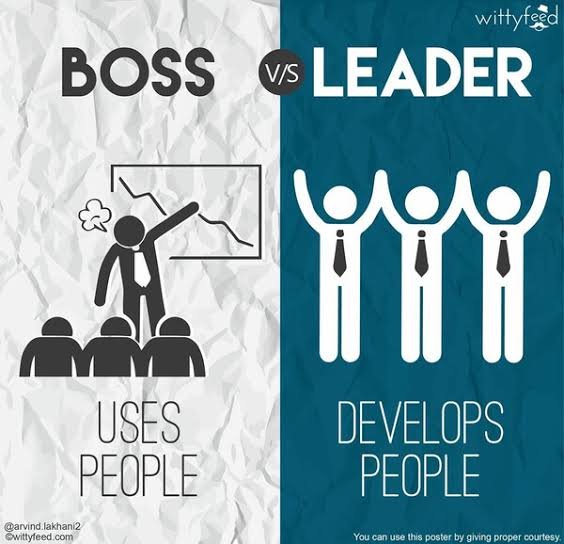
You can hold the exact same job title and still be experienced by your team in completely different ways. That’s really the core of the difference between a boss and a leader — it’s not about the position, it’s about how you use it.
I’ve had both kinds of managers in my career. One boss made sure everyone knew he was in charge, correcting people publicly, taking credit for team wins. A leader I worked under later did the opposite — she gave credit outward and took responsibility inward when things went wrong. The team’s energy under each was night and day.
Authority vs. Influence
A boss relies on positional authority — “do this because I said so, and I’m your manager.” A leader relies on influence — people follow because they trust and respect the person, not just the title.
This distinction matters because authority can get short-term compliance, but influence builds long-term loyalty and genuine effort.
How Each One Handles Mistakes
This is probably the clearest difference between a boss and a leader you’ll notice in practice.
- A boss often looks for who’s to blame
- A leader asks what happened and how to prevent it next time
- A boss might publicly call out the mistake
- A leader addresses it privately and constructively
Teams under leaders tend to report problems earlier, precisely because they’re not afraid of blame-driven reactions.
Communication Style
Bosses tend to communicate downward — instructions, directives, corrections. Leaders communicate in both directions, actively inviting feedback and genuinely listening to concerns, even uncomfortable ones.
Motivation: Fear vs. Inspiration
Bosses often motivate through fear of consequences — missed deadlines, poor reviews, job security concerns. Leaders motivate by connecting work to purpose, growth, and genuine recognition.
Fear-based motivation can produce short bursts of output, but it rarely sustains quality work over the long run. People eventually burn out or disengage.
Taking Credit vs. Giving Credit
A subtle but telling difference: bosses often present team wins as their own accomplishments to senior leadership. Leaders make a point of highlighting individual contributions and giving visible credit to the people who actually did the work.
Development of the Team
- A boss focuses on getting tasks completed
- A leader focuses on getting tasks completed and growing the people doing them
- A boss sees training as a cost
- A leader sees developing people as an investment
Leaders tend to build teams that can eventually operate with less oversight, because they’ve invested in actual capability, not just task completion.
Can Someone Be Both?
In practice, most managers sit somewhere on a spectrum rather than being purely one or the other. The goal isn’t necessarily perfection — it’s awareness of which behaviors you default to, especially under stress, and intentionally shifting toward leadership behaviors over time.
FAQ
Is being a “boss” always a bad thing? Not inherently — some situations genuinely need clear directive authority, especially in crisis moments. The issue arises when directive, authority-based behavior becomes the only mode a manager operates in.
Can you be a leader without an official management title? Absolutely — plenty of people demonstrate real leadership through influence and behavior long before they hold a formal management position.
Why do some companies promote bosses instead of leaders? Often because promotions are based on individual technical performance rather than people-management skills, which don’t always overlap.
How can I tell if I’m acting more like a boss than a leader? Reflect honestly on how your team responds to mistakes around you — if people hide problems or seem anxious reporting bad news, that’s usually a sign of boss-like dynamics.
Does being a leader mean being “soft” on performance standards? Not at all — good leaders can hold high standards while still communicating with respect and support; the two aren’t mutually exclusive.
[link to related guide about leadership skills every manager must have here]
Conclusion
The difference between a boss and a leader ultimately comes down to how you use your position — to control, or to genuinely develop and support the people around you. Neither happens by accident; leadership behaviors are built through consistent, intentional choices, especially in difficult moments. If you manage people, ask yourself honestly this week: when something goes wrong, is your first instinct to find fault, or to understand what happened? That single habit says a lot about which one you currently are.