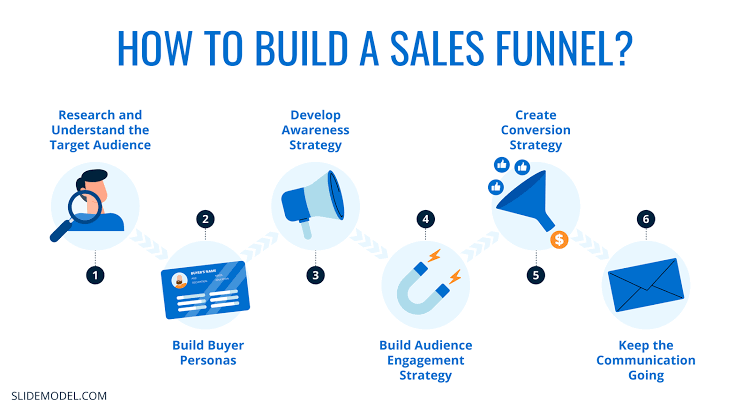
A lot of small business owners generate plenty of traffic or leads but still struggle to convert them into actual paying customers. More often than not, the problem isn’t the traffic — it’s that there’s no proper sales funnel guiding people from “just looking” to “ready to buy.”
I’ve seen businesses with genuinely great products lose customers simply because there was no clear next step after someone showed interest — no follow-up email, no retargeting, nothing. The lead just disappeared into the void.
What Is a Sales Funnel, Exactly?
A sales funnel is the step-by-step journey a potential customer goes through, from first hearing about your business to actually making a purchase (and ideally, buying again).
It’s called a “funnel” because you start with a wide pool of potential customers, and naturally, fewer make it through each stage.
The Core Stages of a Sales Funnel
- Awareness — the prospect discovers your business exists
- Interest — they engage further, checking your website, content, or social media
- Consideration — they compare you against alternatives, look at reviews or pricing
- Decision — they decide to buy (or don’t)
- Retention — post-purchase experience that determines repeat business
Most businesses focus heavily on the top of the funnel (getting attention) while neglecting the middle and bottom, where actual conversions happen.
Building the Awareness Stage
This is where most of your marketing content lives — social media posts, ads, SEO content, referrals. The goal here isn’t selling; it’s simply getting on the radar of people who might need what you offer.
Sales funnels that work well typically use multiple awareness channels rather than relying on just one.
Nurturing Interest and Consideration
Once someone’s aware of you, they need reasons to keep paying attention. This is where email newsletters, retargeting ads, helpful blog content, and case studies come in — all building trust before you ever ask for the sale.
- Share genuinely useful content, not just promotional material
- Address common objections proactively through FAQs or comparison content
- Use testimonials and specific results to build credibility
Designing the Decision Stage for Easy Conversion
This is where friction kills deals. A confusing checkout process, unclear pricing, or a complicated signup form can lose customers who were otherwise ready to buy.
- Keep the purchase process as simple as possible
- Offer clear, transparent pricing without hidden surprises
- Use limited-time offers or bonuses to nudge hesitant buyers, when genuine
Don’t Ignore the Retention Stage
Getting a customer is only half the job — keeping them is often more profitable, since it costs far less to sell to an existing customer than to acquire a new one.
Follow-up emails, loyalty programs, and simply checking in after purchase all strengthen retention and encourage repeat business or referrals.
Using Email Automation to Keep the Funnel Moving
Manually following up with every lead doesn’t scale. Automated email sequences — a welcome series, an abandoned cart reminder, a post-purchase check-in — keep the funnel moving without constant manual effort.
Measuring and Improving Your Funnel Over Time
Track conversion rates at each stage of your funnel to find where you’re actually losing people. If lots of visitors land on your page but few sign up, that’s a different problem than if lots of people sign up but few actually purchase.
FAQ
How long does it take to build an effective sales funnel? A basic funnel can be set up within a few weeks, but refining it based on real conversion data typically takes a few months of testing and adjustment.
Do small businesses really need a formal sales funnel? Yes — even a simple funnel (a landing page, an email follow-up, a clear call-to-action) significantly improves conversion compared to having no structured process at all.
What’s the biggest mistake businesses make with their sales funnel? Focusing almost entirely on attracting traffic (awareness) while neglecting the nurturing and conversion stages where most of the actual sales decisions happen.
Should I use paid ads to fill my sales funnel? Paid ads can work well, but organic channels like SEO content, referrals, and social media often provide more sustainable, lower-cost funnel traffic over time.
How do I know if my sales funnel is actually working? Track conversion rates between each stage — if you know how many people move from awareness to purchase, you can identify exactly where to improve.
[link to related guide about proven sales techniques here]
Conclusion
A well-built sales funnel turns scattered interest into predictable revenue by guiding prospects through clear stages, rather than hoping they figure out the next step themselves. Map out your current customer journey this week, and look honestly for the stage where people tend to drop off — that’s usually the highest-leverage place to start improving. A small fix at the right stage can meaningfully move your overall conversion numbers.